
For decades, excellence in luxury hospitality depended exclusively on the human memory of the service staff. Today, the growing expectations of the modern traveler demand taking that personalization to a consistent scale that can be measured at every touchpoint. However, most hotels face a critical obstacle: data fragmented across multiple disconnected systems that makes it impossible to consolidate a complete view of the customer. Overcoming this gap requires evolving toward an infrastructure of first-party data capable of turning scattered information into a lasting strategic asset.
Luxury has always depended on memory — the problem is that it doesn’t scale
The maître d’ who remembers that you prefer the corner table. The butler who knows you take your coffee without sugar. The concierge who books the same snorkeling guide because last time it was perfect.
For decades, that memory was human, personal, and impossible to scale beyond a single property. Today, data makes possible what only the twenty-year employee could do before: personalization at scale, consistent, measurable, and actionable at every guest touchpoint.
The problem is that most luxury hotels still lack the infrastructure to take advantage of it, and the market is already demanding it.
What the luxury guest already expects — and what the industry still doesn’t deliver
Of luxury travelers are more likely to book with brands that offer personalized experiences (Luxury Hospitality Statistics, 2026)
Of guests expected to receive personalized offers based on their data by 2024 (HFTP / FLYR Hospitality, 2024)
Of consumers expected companies to use their information to offer them relevant proposals (Salesforce, 2023)
The gap between what the luxury traveler expects and what most properties can deliver consistently is one of the biggest untapped opportunities in the industry. The problem is not the willingness to personalize — it is the infrastructure to do it at scale.
The root problem: data fragmented in disconnected silos
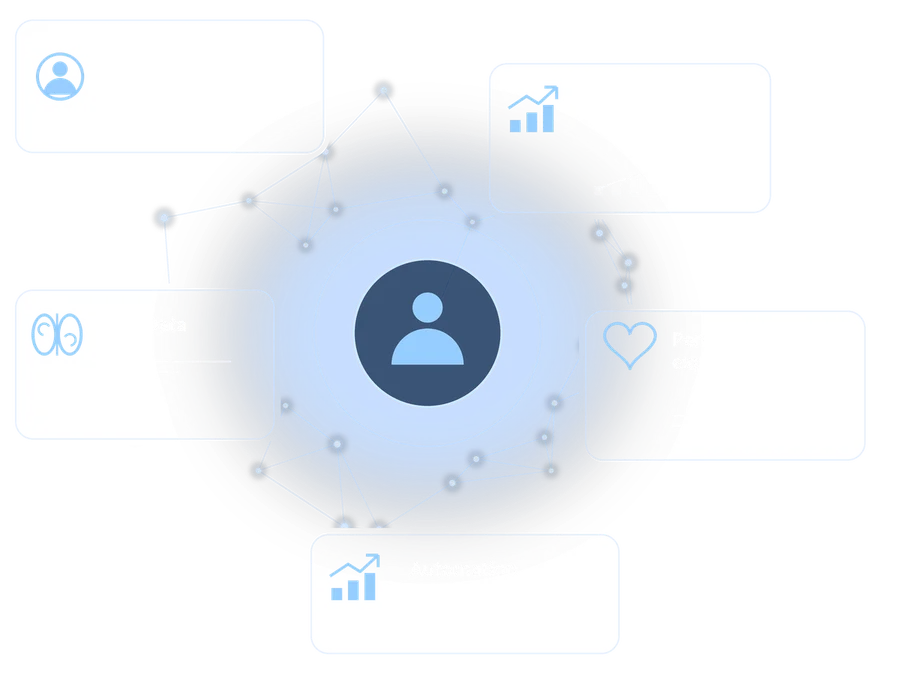
A mid-sized luxury hotel interacts with its guest through at least eight different digital systems: website, booking engine, PMS, CRM, email platform, OTAs, F&B system and social media. Each one generates data. Very few talk to each other.
The result is that no team has the complete view of the guest: Marketing doesn’t know what they consumed at the restaurant. Revenue Management doesn’t know which pages they visited before booking. The on-property team doesn’t know it’s already that couple’s third visit.
“Without a unifying layer, guest data is not an asset: it is fragmented noise distributed across silos that no team can activate with intelligence.”
This diagnosis is the starting point of YIELDigital’s work with every hotel client. At NIZUC Resort & Spa, the initial mapping revealed exactly this pattern: valuable data scattered across six systems with no connection between them.
CDP vs. CRM: the distinction that most confuses hospitality teams
The most frequent confusion in hotel technology conversations is treating a CRM and a CDP as synonyms. They are fundamentally different tools.
A CRM manages existing relationships: service tickets, sales follow-up, communication history. It is an operational tool. A CDP unifies data from multiple sources to create a complete customer profile, regardless of the channel through which they arrived. It is a strategic intelligence tool.
The practical distinction: the CRM tells you who your guest is, the CDP tells you who they are, how they behave, how much they are worth, when they are likely to travel again, and which offer is most likely to convert them.
Of marketers who implemented CDPs reported significant improvements in ROI/ROAS (Carmelon Digital Marketing, 2023)
Average open rate of segmented email campaigns at hotels with a CDP, in segments under 5,000 profiles (Revinate Benchmark Report, 2023)
The three levels of personalization a CDP makes possible
Level 1: Pre-arrival personalization
Use the guest’s available data to anticipate preferences before check-in. Hotels that execute this level well report up to a 20% increase in direct bookings (e-CENS CDP Use Cases, 2025).
Level 2: In-stay personalization
Equip the on-property team with actionable real-time information: room preferences, F&B history, previous requests. The quality of the interaction between staff and guest changes qualitatively when there is data intelligence behind it.
Level 3: Post-stay personalization and retention
The level where the most value is destroyed without a CDP. Without first-party data for relevant communications after checkout, the traveler goes back to the OTA for their next search. A global hotel chain that implemented a CDP reported 25% growth in loyalty program enrollments as a direct result (e-CENS, 2025).
Why timing matters: the value of data is cumulative
The platform gets smarter with every profile it enriches and every campaign it measures. A hotel that starts building its own database today will have, in three years, a competitive asset that a competitor who starts in three years will not be able to replicate. Historical data cannot be manufactured retroactively.
The average time in which hospitality brands see measurable ROI after implementing a CDP is 3–6 months. The first returns come from abandonment recovery and direct booking optimization (CDP.com, 2026)
The NIZUC case: from fragmented data to a unified profile
In YIELDigital’s work with NIZUC, implementing the CDP made it possible to create, for the first time, a unified profile of each guest with booking history, on-property behavior, marketing interactions and lifetime value. The NIZUC team went from segmenting by demographics to segmenting by real behavior. The difference in campaign precision was immediate.
At YIELDigital, first-party data infrastructure is the foundation of every direct sales strategy we build with our clients. Not because it is the fastest solution — but because it is the only one that generates lasting competitive advantages that OTAs cannot replicate or take away.